Cultural Brand Strategist: Managing expectations across borders. Bridging the gap between Western brand identity and Japanese cultural reality, backed by three decades of technical, creative, and marketing leadership.
In 1972, my grandfather was awarded the Order of the Sacred Treasure, 5th Class, for his contributions to U.S.–Japan relations. That same year, I was born into the responsibility of that legacy (yes, that picture on the left is of my grandfather meeting then-Prince Naruhito, who is now the Emperor of Japan).
My work is the modern application of that bridge. Backed by three decades of technical and creative leadership in high-stakes industries, I ensure internal consistency between Western brand identity and Japanese cultural reality.
The Illusion of the “Standard American” Consultant
日本の食・ライフスタイルブランドが「白人の起用」を「市場アクセス」と誤認する理由
(Why Japanese Food and Lifestyle Brands Confuse a White Face with Market Access)
A half century of life experience
Due to the blog, for over a decade I have applied the same mental model to every engagement: What assumptions is this brand (or its advisors) making — and what happens when American market reality collides with those assumptions? Most Western consultants stop at surface-level strategy. I stress-test the hidden cultural, psychographic, and operational assumptions that actually determine whether a Japanese food or lifestyle brand succeeds or quietly fails in the U.S. market. My half century of Japanese-American lived experience is not background — it is the filter that lets me see the blind spots no “standard American” consultant ever notices.
“As an Asian American, and more specifically a Japanese American, I know how the Japanese are perceived and depicted by Americans and in American culture. I know this from a lifetime of lived experience.”
I am a “Western face,” and I am a prime example of an American. Being American is not a racial monolith; it encompasses Black, Brown, White, and Asian identities alike. Yet, overseas culinary and premium lifestyle brands routinely compromise their expansion by outsourcing strategy to consultants based entirely on an outdated, superficial definition of demographics. The prevailing assumption that a white Western profile equates to a master key for the American consumer is an expensive institutional illusion when applied to traditional, regional assets.
When reviewing my portfolio, a traditional Japanese executive might look at my face, note that I look like them, and question my fluency in the mainstream American market. This is the exact objection that must be turned on its head.
“My goal is not to criticize, but to protect the integrity of the very brands that shaped myself and my family’s legacy, and to help Japanese companies succeed in the U.S. market without dilution or costly missteps.”
A white consultant views Japan from the outside as a consumer or a hobbyist. They completely lack the baseline literacy to navigate how mainstream America actually filters, exoticizes, or dilutes a specialized culinary brand identity on the receiving end. They will gladly accept your capital because they do not have a personal or hereditary stake in protecting your product’s integrity.
I know from living in the largest populations of Asian Americans, it’s the secret to entering the US, especially for Asian-based companies.
Furthermore, the assumption that white Americans are the primary gatekeepers to your revenue ignores the ground-level reality of the U.S. food and beverage sector. If you analyze the foot traffic and cash registers at any premium Japanese culinary hub, specialized market, or cultural event across coastal cities, the audience is overwhelmingly Asian American.
In the food and lifestyle space, the Asian American community is the primary demographic engine driving the consumption of premium Japanese assets. We are the early adopters who legitimize a brand, anchor its premium value, and create the cultural gravity required to eventually pull the broader mainstream market in (shout out to all the Asian and Asian American homies).
Most importantly, your brand’s cultural identity is being commercially exploited in the U.S. market before you’ve officially entered it.
I am entirely American by birth, education, and three decades of high-stakes corporate execution. I do not look like the default Western proxy, and that is precisely why I can see what others cannot and why I take it personally when I do. This is not a consulting engagement for me. It is a hereditary obligation to ensure your brand’s integrity arrives in this market intact, and stays that way.
(Why True Branding Requires an Industrial Design Mindset)
I am a multidisciplinary professional who prioritizes objective results over academic theory. My approach is defined by managing expectations: ensuring that what a brand promises is exactly what it delivers in the physical world. Branding is not simply graphic design or aesthetic styling. You cannot effectively communicate a brand if you do not fundamentally understand what the entity stands for.
My process treats brand development through a systems engineering lens, breaking execution down into three critical phases.
Branding (The Promise): This is the core DNA. It defines what the brand stands for, establishing its directional trajectory and dictating exactly what users will come to love, trust, and expect from the asset.
Who You Are: Using Apple as an example, the brand is known for developing software and hardware that are visually appealing but simple and easy to use.
Marketing (The Communication): Once the core promise is defined, I engineer clean physical and digital experiences to convey that exact message. True communication relies on clarity and simplicity, stripping away technical jargon to let the brand identity speak directly to the consumer.
Communicating Who You Are: Apple’s stores and most successful advertisements consist of a simple white background and a silhouette with minimal text, which carries over what the brand is about, which is simplicity, as opposed to tech specs and jargon.
User Experience (The Reality): The marketing strategy must match the actual user experience. Tech specifications and marketing promises mean nothing if the physical reality fails the consumer.
Your Brand Experience: Almost a decade later, the hardware design is simple, but the iOS and iPhone’s user interface has remained consistent with their brand: intuitive and easy to learn and use. Tech specs and jargon mean nothing if the user does not experience it.
I protect the integrity of a brand promise when it crosses borders, ensuring that premium concepts retain their authenticity, value, and precision whether that promise is engineered into a two billion dollar Italian brand or crafted into a traditional culinary asset.
(After over a couple of decades in and out of the automotive aftermarket building the top companies in the industry, I felt a void of purpose).
Anybody can generate ideas, but true strategy requires the capability to implement those ideas within strict operational constraints. Over three decades of technical and creative leadership, I have worked side by side with founders and key stakeholders across diverse industries to listen, strategize, and iterate market-leading brands. As a founding member of entities like Skunk2 and Axial, I spent a decade and a half building elite, dominant companies in the high-performance automotive aftermarket and motorsports sectors.
As a brand specialist, I worked side by side with founders and key stakeholders to understand (listen), envision (strategize), and develop (iterate) industry-leading brands, with a lot of good times in between.
Anybody can come up with ideas, but you have to come up with ideas that you can implement with the resources you have.
I worked in several industries, but over the last decade and a half, my focus was on building leading companies and brands, including as a founding member of Skunk2 and Axial, many of which became leaders in their respective segments.
When the pandemic altered the restaurant landscape, I applied my brand architecture frameworks directly to regional Japanese food culture. In the American market, mass food distributors routinely exploit a lack of cultural literacy, selling instant ramen kits and powder bases to establishments outside of dense coastal enclaves. I launched the Taniguchi Ramen pop-up to actively fight this market dilution, producing a traditional Hakata-style tonkotsu entirely from scratch, including all three primary stock components.
Focus: I love cars and motorsports, and when I get into something, I go all in. That same intensity found a deeper purpose in Japanese food. I gave up plenty for it, no regrets. I’d do it again.
Process-driven and able to work across multiple industries
I bring that exact same high-tolerance execution and refusal to compromise to the culinary space.
303 Night Market was an event planned for micro and small businesses in Denver, Colorado. Taniguchi Ramen was a pop-up that started in August 2019 but shut down in February 2020 due to the pandemic. Also, due to the attacks on Asian Americans, I helped raise $14k with Karl Palma to give out to neighborhoods in the form of food (we partnered with GoGoCurry). Your Stomach Loves Us was awarded $5k by GoFundMe. Oishii Desu is one of the largest, if not the largest, online English resources (16-21k to 33-38k unique visitors per month) for Japanese food and culture in the United States.
Latest from Oishii Desu
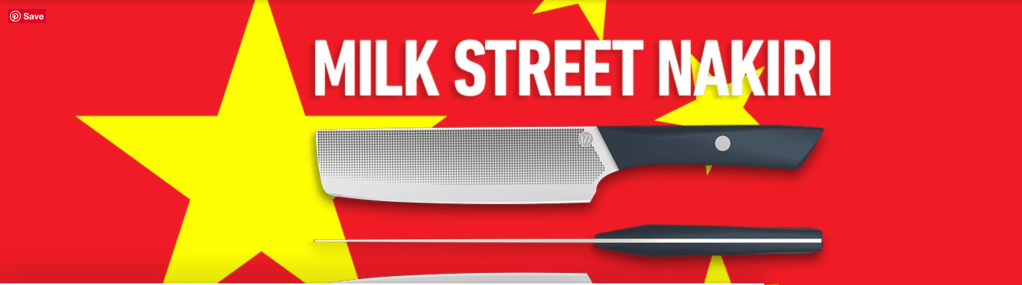
Milk Street Nakiri Review: A detailed look at how Milk Street markets Chinese-made knives as “Japanese-style,” using Japanese terminology and prestige while the products themselves have little connection to Japanese steel, design, or manufacturing. Full critique on Oishii-desu.com.
Case study: from Human Centered Design (HCD) to User Experience (UX) design
User EXPERIENCE (UX) LEAD
Race Technologies, LLC: official partner to Brembo for logistics and market management of the Brembo Sport/Performance, and Racing programs. Brembo, S.p.A. is an Italian manufacturer of automotive brake systems, especially for high-performance cars (Ferrari, Lamborghini, Lexus, to Cadillac) and motorcycles (Aprilia to Triumph) based in Bergamo, near Milan. My role: I worked with the CEO/founder throughout the entireUXR (User Experience Research) processfrom the research to concept/sketching, site maps, task flows, lo/hi-fidelity wireframes, to measurement.
What the market calls ‘UX’ today is simply Industrial Design rendered in pixels. My roots in classical ergonomics and early front-end development taught me an absolute operational rule: a brand is a promise, and the interface is where you deliver it. If your digital touchpoints introduce the exact friction your positioning promised to eliminate, your brand strategy didn’t fail. It lied.
Until I wrote my manuscript, I also never realized how culture and branding are also closely tied together.
Imagery is of the Kilometro Rosso where Brembo is headquartered.
Three examples of how we connected people to Brembo
At RT, our objective was to “be the solution,” which meant RT’s role was to make the process of purchasing and servicing Brembo products as quick, simple, and enjoyable an experience as possible.
A Brembo 6-piston CNC’d nickel-plated caliper (I also shot this product).
1. The diversity and specialization of dealers and distributors
Developing the “dealer locator” feature always takes me back to when I bought my Cannondale bike. On the Cannondale website, they have their bikes segmented into “mountain,” “electric,” “road bike,” “urban,” and “women,” yet they have their dealers lumped all together. That made it hard to locate what I was looking for since their dealers do not carry the entire product line, and many of them specialize in one type of bike more than another.
That same diversity of products and dealers was a lot like the Brembo Performance market, which was identified through user and product segmentation research (we had a staff with a minimum of 8 years’ experience). The data we gathered contributed to the development of the locate-a-dealer functionality, which allowed the user to find a shop that specialized in having their Porsche set up for a track day or to find a tire and wheel shop for a routine pad/fluid change.
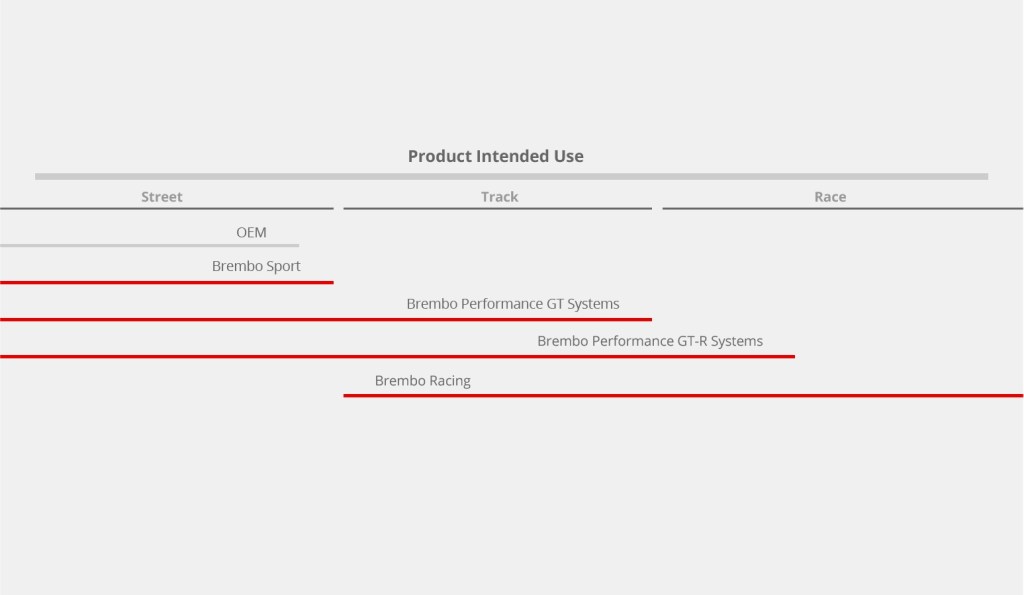
This may look simple, but it is also what makes it so effective because it depicts the Brembo aftermarket product segments’ intended usage.
2. Brembo has been a partner with Audi amongst many others
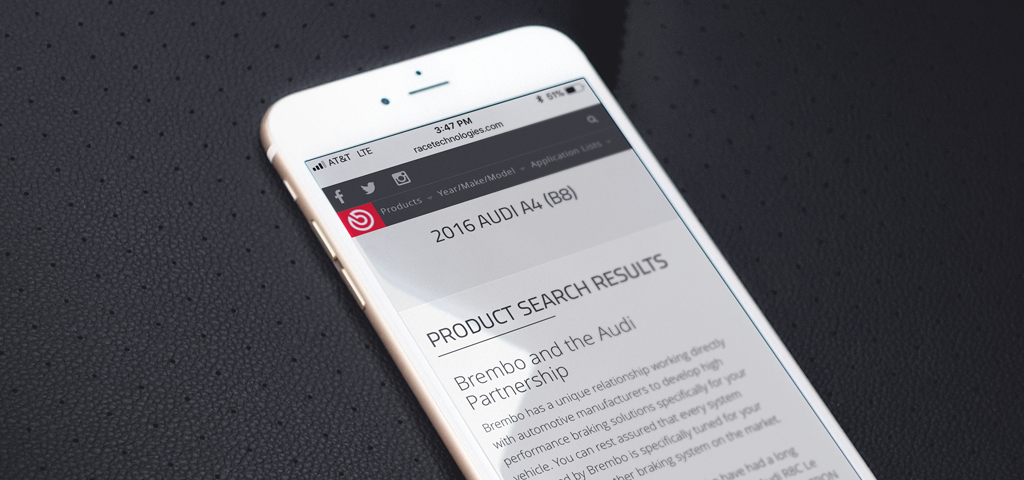
A marketing objective was to communicate Brembo’s capabilities, which was to juxtapose Brembo’s massive involvement in not only racing but also as an OEM supplier compared to the smaller and limited capabilities of other products in the market. To achieve this, one tactic was to have every “year, make, and model” search deliver a small brief on the product results page about Brembo specific to the “make” search, such as with Audi:
“Audi/Quattro GMBH and Brembo have had a long relationship, from supplying the original Audi R8C Le Mans Prototype all the way to the current R18 e-tron quattro. Brembo also supplies the Audi R8 LMS Ultra GT program as well. Brembo can be found on several high-performance OE Audi platforms like the Audi R8.”
3. From noobs, track rats, to industry pros
User-specific product descriptions: Content was designed to match the level of experience and knowledge of the user, so for the application lists, we designed the extent of information/terms to cater to dealers. Whereas general product information was aimed at users not as familiar with the products and product lines, so we focused on the benefits over citing extensive product specs like a “355mm disc diameter, 32mm disc width, 54mm annulus, 16mm air gap, and a 48 vane curved vane design.” That was replaced with “upgrade and replace your heavy 1-piece rotor with a lightweight 2-piece disc system: comprised of an aluminum bell and outer iron disc…”
None of this would have been possible if it weren’t for the collaboration of several people inside and outside of RT.