
Yes, that title is a play off of LL Cool J.
Due to what I do as a cultural brand strategist, and being back in Hawaii this September, I got served the Pacific Business News article courtesy of the algorithm: “L&L Hawaiian Barbecue hires national PR firm as plate lunch competition heats up on Mainland.” A brand I just had to write about.
L&L, the name, is a remnant of the L&L Drive-Inn on Liliha Street from back in 1976, and it’s another brand that native Japanese speakers should have trouble pronouncing, which would have them sounding like “radies rove Arr, Arr Coor J.” Yes, I know most people think all Asian accents are the same, but it’s Japanese phonology specifically that has the problem with “L’s.” Except, if you know nothing about Asians, you wouldn’t know this.
Being back in Hawaii conjured up a lot of memories of back in the day: slammed mini-trucks, of course they were Toyotas (Hilux / 4th and 5th Gen), LL Cool J and Going Back to Cali debuting in 1987, the lyrics and deep bass filling the streets while cruising making an impression on a Colorado boy, and Hawaiian Island Creations (HIC) to Maui and Sons. I have great-grandparents, great-uncles, great-aunts, uncles, aunts, and cousins there. The list goes on. I can also add the girl I “dated,” and the one I dated from Japan who worked at Shirokiya where my uncle was a buyer, back when she was a pâtissière at Kulu Kulu. Beyond a homie’s destination wedding on Maui in 2015, those were connections and my last visits prior to COVID.
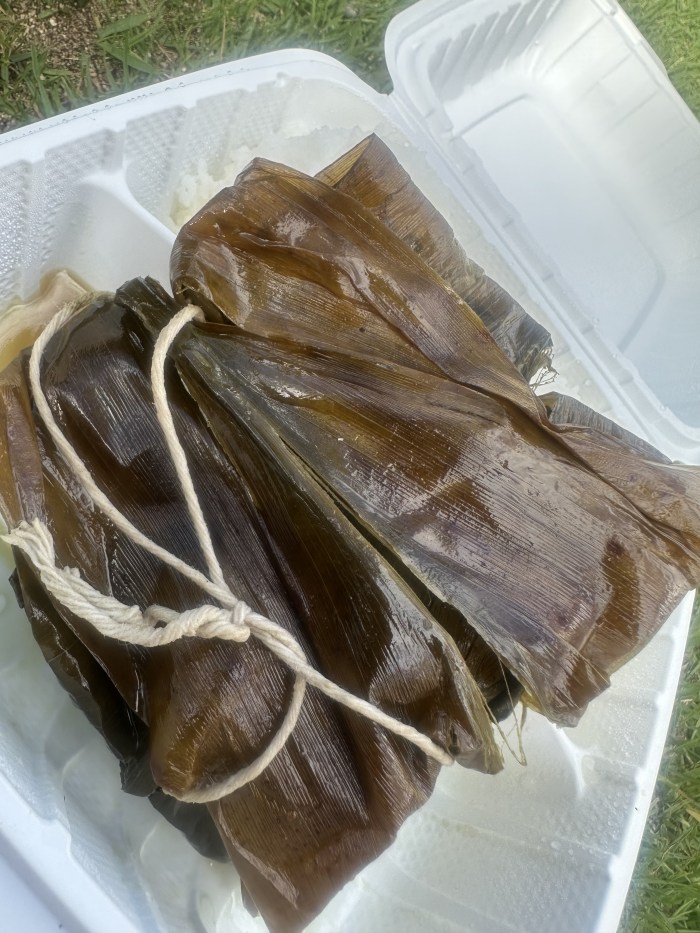
The only plan on my agenda was to eat lau lau and visit my uncle and aunt’s burial plot at the Punchbowl. I ended up riding there from Waikiki in a torrential downpour on a Biki bike, which sucked, but it cleared up once I arrived. Since I love food, each memory I have of our family trips to Hawaii involved eating. But my exposure to Hawaii wasn’t solely from those trips. It was also my grandmother’s cooking, which attracted upwards of 50 to 60-plus people cycling through during the holidays from Thanksgiving to the New Year (my mom said it was even bigger when they were still on the farm). It was an all-day affair from morning to evening, with people stopping by throughout the day to say hi, drop off more food, and eat. We not only had the upstairs table filled with food, but the basement had two or three tables covered from end to end.
Out of all that food, my go-tos were shirai (with an extra dash of shoyu), yamagobo, hijiki, and I would always eat my grandmother’s pak kai. It was my favorite. To every mainlander, it’s “Hawaiian” simply because of the pineapple, even though a Greek-Canadian is the one who came up with Hawaiian pizza. The dish is savory-sweet from pineapple juice and shoyu, where the natural enzymes and acid worked double duty to tenderize the pork riblets, all simmered alongside bell peppers (which I avoided and selfishly picked out the meat, come on, I was a zit-faced kid), onions, and pineapple chunks like retirees in a hot tub. My grandmother was born and grew up on the Dole Pineapple plantation in Waipahu: Exit 8, the origin of it all, and that style of food considered China Meshi.
As a kid, no one broke each dish down for you: this is Japanese, this is Japanese American, this has Portuguese and Chinese influences. There was a lot I didn’t realize until I wrote my manuscript, or until I learned more on my own as an adult. Even to this day, I wonder why we ate tuna sashimi with lettuce, but grandparents on both sides did it, and they weren’t chummy. Other regional quirks included fried wontons instead of the steamed-and-pan-fried gyoza style. As for the rest of the local Hawaiian staples during those summer visits to Oahu, I remember trying poi for the first time and thinking, “Ewww, poi is sour” (we likely had the slightly fermented version rather than the fresh stuff), and lomi lomi salmon was too slimy for me back then, but lau lau, I’m all about it brah.
Fast forward to 2004 when I first moved to LA from the Bay Area via Colorado. An ex-Filipino homie of mine whose definition of “dayummmn, it’s the bomb” simply meant large portions for the price kept hyping L&L when I moved to LA and we were living in West Covina. Since we lived off Citrus, the spot we frequented was on North Azusa Avenue. That location opened in 2003 during L&L’s early Southern California expansion, following the debut of their first continental U.S. location at the nearby Puente Hills Mall in the SGV in late 1999.
Beyond L&L, there’s a bunch of plate lunch spots throughout LA, but the biggest contender is Ono Hawaiian BBQ. I remember them because of the name, though I can’t recall which location I hit up for the first time. All these spots bug the eff out of me because I see what they’re doing back of house, especially with anything dredged in panko or dipped in heavy batter. I expect more out of Ono because of my perception of Taiwanese standards in general. The Liang brothers, Joe and Joshua, are Taiwanese Americans who opened their first shop in 2002 at Santa Monica Boulevard and Bundy Drive in West LA. Now headquartered in Diamond Bar, right in my old backyard when I lived in San Dimas before moving to Newport Beach, they hold the largest physical market share for fast-casual Hawaiian plate lunch across LA and Orange counties with over 100 locations.
I won’t get deep into Gardena, Torrance, or the Cal, aka the California Hotel & Casino in Las Vegas and the one-offs, though when I think of the Hawaiian diaspora, that’s where they are. (I chuckled and laughed in a very quiet room by myself while writing that.)
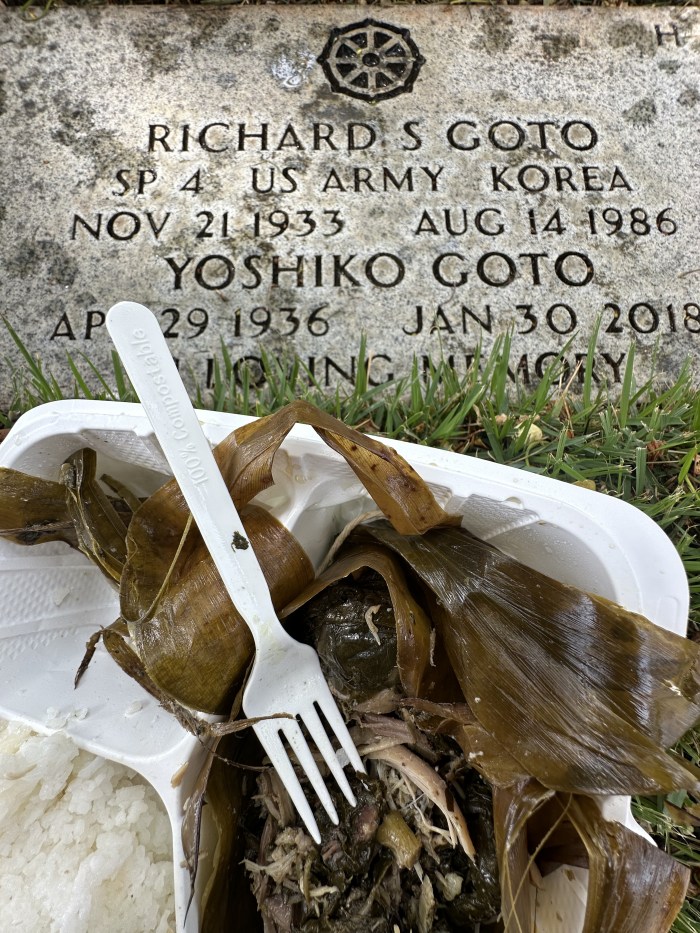
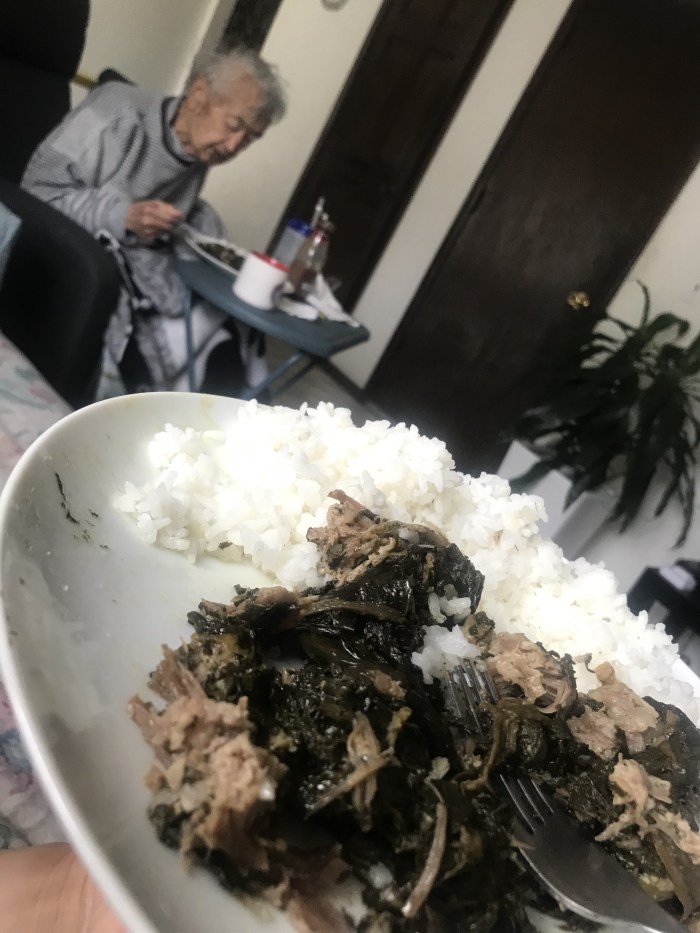
Now, the real reason I’m writing this goes beyond just loving lau lau. If you’ve ever been to an L&L and asked for it, it’s either frozen solid or they claim they don’t have it because it’s not a high-velocity item. Most mainlanders probably don’t care for anything green, especially the dark green luʻau leaves wrapping the fatty goodness into a cocoon-like pod bound in ti leaves. Just look at how parsley is handled on the mainland: in the US, it’s purely decorative, whereas Argentines turn it into an epic chimichurri and Brazilians throw down with their cheiro-verde (parsley and scallions). Even when I shared lau lau with another Japanese girlfriend, she found it disgusting, which shocked me. It also bugged me because if I were on that show about last meals by Mythical Kitchen hosted by chef Josh Scherer, lau lau might make my list. I ate it with my dad before he passed away in February of 2022, a meal I paid a premium for in Colorado. Keoki’s is the brand often found in my freezer; I break them off after a slight defrost (they come in a pack of three), preferring them over the Ono Food Co. brand. Over the last two decades, I’ve watched that pack climb from $8 to over $20. During this recent trip, I sat at the Punchbowl cemetery and ate it with my uncle Dick Goto and my aunt Yoshiko Goto. My uncle, who I think was from Hawaii (didn’t I tell you, we never got told about the food, but that includes anything about our extended family), always had an aloha shirt on, and he had a major impact on me growing up: teaching me not to be a katonk aka a dipchit.
Contrast that with the tonkatsu, Korean kalbi, mac salad, two scoops of rice, teriyaki chicken, bulgogi-style beef, and filler ingredients like cabbage. These have become commoditized items you find anywhere throughout LA when someone is grinding away back of house to produce anything to keep their doors open. The hustle includes anything pulled straight from a freezer bag, from crab cheese wontons to broccoli filler. That’s the direction Ono Hawaiian BBQ runs, and it reminds me of Rick Bayless trying to adhere to traditional Mexican roots, versus Chef Morimoto getting ridiculed on Iron Chef by Kandagawa and Ohta. Both openly criticized Morimoto for what they called bastardized, gimmicky cooking, arguing he didn’t respect washoku orthodoxy and was just making novelty fusion for Americans, doing whatever it takes to appeal to the masses. I get the Morimoto haters because the fusion in Hawaii with local cuisine was tested by the community over generations, with stakes and constraints (plantation wages, what was on hand, who was at the table). Most chef-driven fusion is con’fusion, and Morimoto’s steez in the kitchen is the Iron Chef exhibit: one person, all on whim or cuz “chef.” Ono takes what the community tested and runs it through a freezer bag.
That’s what’s happening in fast-casual plate lunch. You see it in the equipment packages: what minimizes training, what speeds ticket times, and why deep frying reigns supreme. That’s how I view both L&L and Ono: headed toward the haole version of Yoshinoya, the white-washed American one that doesn’t match what you’d eat in Japan (sorry to my Whites, but I typically say “you people” in my manuscript, but in this case, I have to go with the H-word, bruh). There’s no kokoro in it. It’s simply a fast-casual assembly line.
Pressure from private equity bros to mirror and match models often turns into a race to the bottom, though execution varies (Exhibit A: what private equity did to Mikawaya in Little Tokyo). Take Hawaiian Bros, the private equity darling founded in the Midwest and expanding coast to coast. They stripped the concept down even further than L&L did: no fryers, no freezers, and no microwaves. They run just six core menu items (looks like Panda Express), push 30-second drive-thru ticket times, and still only average about $2.4 million per store across the system, roughly $2.5 million on the franchised side. The $3.5 million figure is the top quartile, not the average, and management has said out loud that $3.5 million is the target, not the current number. Even so, the stripped box is built to beat legacy plate-lunch shops on throughput, not on the plate.
On the other hand, the real Hawaiian brothers, Kalani and Kimo Mack, are definitely legit. They founded Mo’Bettahs in 2008, anchored primarily in Utah. Having worked at a Mormon company, I recognized the influence: Elder Kalani and Elder Kimo run it with a compass of consistency similar to Chick-fil-A or In-N-Out. Maybe that’s why they understood the assignment. Plus, their product photography is mo’bettah than the rest (yeah, I went there; cuz, taking pictures of food is in every Asian person’s blood anyway).
Between L&L, Yoshinoya, and Flame Broiler (founded by Korean American Young Lee, who opened his first location in 1995 in Fullerton right off Chapman near Cal State Fullerton), they’ve all been reduced to flattened, cultureless protein receptacles. Further up the chain is Urban Plates, a spot I frequented with coworkers in Orange County. The formula is identical: grill or roast a protein, pair it with carbs, and market it. It’s a tale as old as Furr’s Cafeteria and Boston Market, served with a dash of culture and some healthy buzzwords (Atkins, No MSG) tossed in for Middle America.
I don’t do what the CEO does, or what the upper management team (C-suite) handles, and I stay in my lane: analyzing where business and culture intersect. When it comes to L&L or any mainland spot touting local food, I think of how the mainland butchered poke until it became “pooky.” The worst example was an Asian couple running a shop who marketed poke as “deconstructed sushi.” I wasn’t the only one pushing back. Anytime a cuisine gets monetized, it shouldn’t become an absolute free-for-all. Culture exists for a reason. Dudes like Chef Gene Villiatora (Oahu native and Top Chef contestant) of ‘Ai Pono Café in Costa Mesa and Las Vegas actually get it. I say “get it” because after living nine years in Newport Heights, I followed his moves on social media as he set up shop near where Krav Maga, Bruxie, and Pinkberry used to be on 17th Street, down the road from Tony and Sue at MaDee and Yuki and Toshimi-san at Shunka. Gene reps the 808 like Mayumi-san does with Okinawan cuisine.
It’s not rocket science why certain chains scale while others stall, and it has nothing to do with not having enough items. Otherwise, Taco Bell and In-N-Out would be out of business. There’s a paradox here: the mainland model was engineered as a scalable, low-skill, deep-fryer-reliant chassis. That’s why L&L is hiring a national PR firm while the plate lunch fight heats up on the Mainland. Once the food is reduced to what any trained crew can plate from a freezer and a fryer, the remaining competition is for story, not for the plate the plantation tables actually tested. The question comes down to this: do you want to be a soulless, liminal-space McDonald’s clown show, or an operation like In-N-Out, built on an uncompromising standard based on faith and a brand identity that never wavers?
I lean toward heart. Otherwise, why are we doing what we do? AI and robotics will handle the heartless stuff. But we need to preserve the contributions of the immigrant laborers: Cantonese, Japanese, Filipino, Portuguese, Native Hawaiian, and others who made that plate more than just a plate. Except, it isn’t only the mainland pookyizing it, and it falls to fellow kamaʻāina to tend it.
🤙 Mahalo for reading.
