
My first SEMA Show, the automotive aftermarket’s premier trade-only convention held annually during the first week of November at the Las Vegas Convention Center, a total sausagefest, was in 1994. I went with my parents. It was my first time in Vegas, and it was also the first time I ever saw a Filipino.
When I was finally able to break away from my parents, I decided to check out Circus Circus, the peak luxury hotel in Vegas at the time (ok, I’m lying, it seems like it was always a dump). Back then, they had the Midway arcade, when arcades were a thing and that is what dudes did at the time. While I was seeking out Street Fighter II, or the new Darkstalkers: The Night Warriors, I was navigating the dimly lit interior, with a pocket full of quarters, amongst Daytona USA and Virtua Fighter 2, with the lights and sounds of Mortal Kombat II filling the darkness. My only reference was likening it to the Santa Cruz Boardwalk, a place I had not been, but in high school in Colorado, while I grew up with the jocks, I typically hung out with the emo and punk rock types. That might explain why I got The Lost Boys movie vibes where I felt like I’d see David (Kiefer Sutherland), Paul, Dwayne, or Marko. At that age, though, it’d be even better if it were Star (Michael’s love interest), though not like my twenty-something self would have approached her anyway.
Except, no caucasoid-like vampire characters, and what I saw were a few kids circulating through who looked like a mix of Latino, but Asian. Growing up in Colorado, being Asian was always a binary of “are you Chinese or Japanese?” At that time, it remained a mystery until I think I finally learned about Filipinos when I attended one of the top schools in San Jose, an institution that both Steve Wozniak and Steve Jobs had attended at one time: De Anza (ok, I’m lying again, it was a junior college, and Steve Jobs lived a couple of miles away and only took intermittent courses, but he and I are alumni).
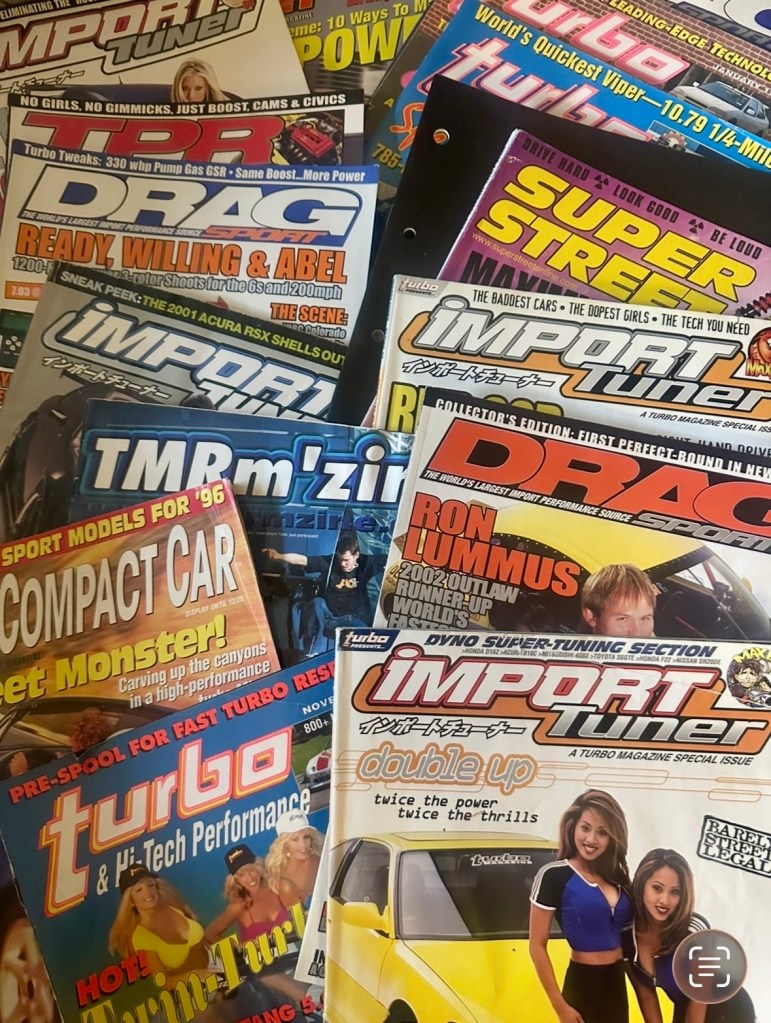
Some might wonder, “Bro, you’re from Colorado, how did you even get into the tuner scene?” Well, that was primarily due to an older Chinese dude from Los Angeles who had moved to Colorado in the late eighties with his extended family. Essentially, Los Angeles came to me. I still remember the first time I saw his blacked-out, lowered ’86-’87 Honda Civic Si with the hieroglyphic-like Mugen kanji on the rear body (a debossed aluminum kind, not a sticker). After spotting it out on the street, I got to know the family through school because his niece and nephew attended the same high school. Especially since if you’re Asian, you’re going to know the other two Asians out of probably about six total, and one was my sister, the other my cousin. If I didn’t, I would not have known or learned that it had a Mugen kit, Mugen exhaust, limo-tinted windows, PIAA lights (maybe 90 Pros), a MOMO Porsche Design steering wheel, and 15-inch Autoform wheels with 205/50-15 Yokohama A008s. That spec sheet stood out back then, and what is even more impressive is that a build like that would be respected at any local car show today.
I loved cars so much that I took a job as a lot tech just so I could drive different cars. The first spot was Mile High Honda, which also handled Acura and Mitsubishi, right when the Acura NSX first went on sale in the US market in August 1990 as a 1991 model year vehicle. The next job was at Kuni Lexus, right after Lexus launched in the US in 1989 for the 1990 model year. Not only did I drive an LS400 to do errands for the dealership, but I’ll never forget when they got a Mercedes-Benz 190E 2.5-16 Evolution II. It was a limited edition that came out in 1990 with a production run of only 502 units, carrying an auction value today of $280,000 to $420,000+. Yes, the early nineties was an epic time for car culture.
Now that I think back 32 years ago, it is laughable how that 1994 Vegas trip was such a strong memory, and that was also because that year GReddy (the performance division of Japan’s TRUST Company Ltd.) made its official presence at the SEMA Show. It followed the March 1994 establishment of its North American subsidiary, GReddy Performance Products, Inc. (GPP), that once had an indoor racquetball court that they turned into an impromptu showroom. I remember those details because they were one of the only Japanese tuner companies back in the day with a presence in Southern California or anywhere in the US.
Let’s get this straight, if you did not know: SoCal is the capital of car culture in the United States. Almost every trend or big aftermarket car builder is in SoCal, which is why Art Center College of Design is in Pasadena (where I had wanted to go after SJSU), and why major manufacturers put their design studios down there, like Toyota’s Calty Design Research in Newport Beach, right near where I would later live. And, now you know foo.
Now back to the mid-nineties, a time when the tuner community was small because there was no internet or dedicated publications, and it was only the large auto enthusiast ones like Road & Track, Motor Trend, to Car and Driver giving small tuner shops like Modern Garage Aero (MGA), St. Andres (HKS and Kaminari), King Motorsports (Mugen), and Turbo City any visibility in the back pages to car enthusiasts at that time. Since I had a Toyota back then with a 4A-GE, with 15-inch five-spoke OZ Fittipaldis, I knew what it was like ordering TRD (Lou Fusz Toyota in St. Louis, Missouri) and HKS catalogs that would sometimes take months to get, or not get at all.
Because I am a car dude, and I was an aspiring industrial designer at the time, it never mattered to me whether a car was of American, European, or Asian origin, I loved them all. So did my dad, so we had, and I still have, stacks of those magazines. Also, my mom still has her ’68 Mustang in seafoam green, and it was my inspiration when I sent a rendering of a future Mustang design based on her car into a magazine contest that unfortunately disappeared into the void. That passion for cars led me to San Jose, and it is where I started my first business off of Saratoga Avenue. The same spot where I used to go to the Kinokuniya bookstore at Yaohan (now Mitsuwa) market and buy industrial design magazines for something like $25 an issue, along with a variety of other full-color, glossy, Japanese tuner magazines which made American publications look cheap in comparison. I could not read a single word of them, but they were stuffed from cover to cover with every Japanese tuner company and enthusiast brand from Recaro to OZ wheels.
Since I had my business at that time, I experienced all the automotive aftermarket trends firsthand. It went from stickers (yeah, stickers, like, I think his name was Eddie who owned Tokyo Auto Trenz up in the Bay Area at the Kintetsu Mall in Japantown), to street lights, RS Akimoto intakes, and lowering springs like Eibach Sportlines, to the moment a brand I helped build put out a sleeve-over coilover kit for around $250 when the competing brand retailed for upwards of $350. That single product ignited and launched a company that went from primarily strut tower bars and lower arm bars (Z.Speed), to Skunkworks, to eventually becoming Skunk2. This was at a time when a mix of domestic and Japanese tuner companies from HKS, DC Sports, Dan Paramore, JG Engine Dynamics (Dynamic Autosports), A’PEXi, ACT, Clutch Masters, MSD, NOS, Wings West, to AutoMeter helped shape the foundation of the tuner scene we see now in 2026.
All of those companies only existed, though, because of the specific cars that drove the popularity of it all. Unlike what some might think, in the nineties, it was probably about 90% all Honda Civics to Acura Integras, with the Mitsubishi Eclipse crowd, and the rest were the dudes who had a Toyota Celica, a Nissan Pulsar, or a Sentra, with the occasional unicorns: the 300ZX (Z32: the two-page magazine spread hung on the wall of my bedroom), RX-7 (FC3S and FD3S), and Supra (MA70 and JZA80). That breakdown matched the racial, age, and income demographic of the scene, which I’d say was 95% or higher Asian: Vietnamese, Chinese, and Filipino primarily, with Koreans and Japanese somewhere in there at ratios that reflected the overall community size. Oh, and this dude, Shaneel Sharma, that scammed me with his fake credit card for his clutch.
Then on the flip side of it all were the Foxbody and other domestic car dudes, which included one of the former founders of Skunk2. Everybody was divided by race and tribe back then. It was, exactly like the magazine section of a Barnes & Noble, divided. I also remember the time I was in the car section looking at the growing number of import tuner magazines, starting with the first and big one, Super Street (October 1996), then Import Tuner (Fall of 1998), and the rest. As I was taking it all in, a Latino dude standing next to me with his little bro, who had a Lowrider magazine in his hand, was looking at the import titles and mumbling to his little bro about how imports were BS or something. The homie was throwing shade, which was completely expected at the time. The whole “my Mustang’s lug nuts require more torque than your Honda puts out” remark was constantly yelled at all of us while we were at the drag strip trying to get into the 15-second quarter-mile range.
Large-displacement V8s versus small-displacement engines was the focus of one of my ads that I created for Skunk2 back then. I titled it “Replacement for Displacement” because our Integra, Project Beta, then the RSX, Project Delta, dominated the all-motor class over a span of several years, ending in the high 9s. Fast-forward to 2026, and not only are OE manufacturers producing ridiculous amounts of power from tiny, small-displacement 4-cylinder engines that put old V6s and V8s to shame, but the latest standard Toyota Prius, a car sought after for fuel efficiency, not performance, now runs the quarter-mile in about 15.4 to 15.6 seconds (at roughly 91 mph), while the faster plug-in Prius Prime drops that time down to 14.8. Those nuts on those Foxbodys transitioned to the new SN-95/Fox-4 platform in 1994, and it ran the quarter-mile in roughly 14.7 to 15.7 seconds depending on the trim and transmission. If you could pull a Biff Tannen and have access to a flux-capacitor-equipped Prius, you could race them for pinks in a Prius and still get 50+ mpg.
I can’t write an article like this and not mention the positive and negative impact The Fast and the Furious movie franchise had on the industry when the original movie came out in 2001. I cannot depict it as completely bad, because it brought in a massively more diverse demographic and made Universal Pictures and Vin Diesel ginormous amounts of money across 14 movies and counting. There is a simple reason for the appeal of the franchise: non-white audiences accounted for 70% to 75% of the total box office. Hispanic and Latino viewers represented roughly 35% to 40% (Hispanic and Latino Americans consistently buy more movie tickets per capita than any other demographic group in the United States), African Americans made up 20% to 25%, Asian Americans comprised 10% to 12%, and Caucasian audiences accounted for the remaining 25%. Post-FNF, the scene slowly got back to form, and I would say to peak form. The builds I see now across American, Euro, to Asian imports are next level.
You had the good, now the bad and ugly. I liken what the FNF franchise did to Japanese imports to taking Japanese sushi, busting a load of mayonnaise on raw fish “cuz Murica,” adding six other ingredients from cream cheese to Hot Cheetos, drowning it in four sauces, and calling it sushi. What was once an Asian American thing, Hollywood turned into an Americanized interpretation of the nineties import tuner scene with the accuracy of Josh Brolin’s movie Thrashin’ from 1986 (which, by the way, I just watched him reference in the most recent Theo Von podcast, episode 690, and it’s hilarious). For several years, it nearly destroyed what Japanese imports and the scene were all about with its cheesy, campy take on things, getting so bad that it spurred the Crispin Porter + Bogusky (CP+B) ad agency to release the “Un-pimp Your Ride” ad campaign for VW from 2006 to 2009, which I found to be hilarious with some spot-on messaging.
It was not always like this, and the journey of the Japanese automotive industry in the United States post-WWII wasn’t without its challenges, peaking in the eighties with the pure hatred for the Japanese that led to the death of Vincent Chin (RIP, my Asian bro, Vincent Chin, who was beaten to death in 1982 with a baseball bat by Ebens and Nitz, who only served three years of probation, a $3,000 fine, and court costs, with zero prison time). To further stir the pot, the movie Gung Ho (1986) came out about the automotive industry. Fifteen years later, Hollywood flipped to the automotive aftermarket with the first Fast and the Furious, which at least got some of the vibe right with a dude’s house being raided by SWAT. Then came the heinous sequel where Asians bend over backwards for a white guy, tossing him a free car and a girl cuz he’s a total Bobby-Sue, the protagonist’s wet dream, aka The Fast and the Furious: Tokyo Drift. A movie in name only, because much of that movie had nothing to do with Japan or Tokyo, as it was shot mostly in Los Angeles with only two of the core actors being Japanese. By the time you get to the latest chapters of FNF, Asians have been almost 86’d from the sequels, reduced to one token dude whose whole thing is to eat snacks while the rest of the cast jumps cars from skyscrapers like some generic Hollywood action movie. Meanwhile, the Japanese import side still has the “you people” taint stench of calling imports “ricers.” Since you people associate food with racial groups, FNF is the Flamin’ Hot Cheeto sushi roll of movie franchises.
I spent over three decades in and out of the industry, and as a car enthusiast, I think I have heard it all, but I wanted to address car enthusiasts in general when they say and expect: “Why don’t new cars look like the freshened-up version of iconic nineties models?” “It better be a manual transmission.” “Have you taken it on a track yet?” “Fuck EV, I like to hear the engine.” All performative to the tribe, like the virtue signalers out to prove they’re smart, anybody who repeats those phrases is just proving their loyalty to a tribe.
Take the fanboy crowd that insists cars coming out in 2026 should look like the models from the nineties. The vast majority of cars in the nineties may have carried over a design element or two, but for the most part, they looked very little like their predecessors. A JZA80 Toyota Supra has a totally different design language with very few design elements from an MA70, other than the era-specific rear haunch that Toyota and Lexus put on the Supra, LS400, Celica, MR2, and probably a few more during that period, I want to say Camry. Yet when news came out that Toyota, with Akio Toyoda at the helm (I love what the dude is doing for the brand because he gets it), might bring back the Celica and MR2, every rendering was just a slightly tweaked nineties model. Unless you are talking about Porsche enthusiasts, car design moves on. An Acura DA3 looks nothing like a DA9, to a DC2 (though the Type R in Japan did adopt the OG DA9-style headlights), to the DC5 that tried to go upscale with their new naming convention from the Integra to the RSX. And most non-car guys complaining about design can’t even tell the difference between the S2000 and “it looks like” a BMW Z3. If you can’t tell the difference between a Ferrari Purosangue and a Mazda CX-30, then a Chrysler 300 is also a Bentley.
Next is the “I’m a real one, a real car dude that is, so I require a manual transmission all the time, every time” requirement. Hondas and Acuras dominated the nineties because DOHC VTEC was the game-changer for imports. My AP1 S2000 was a manual transmission that I owned for upwards of a decade, and with a rev-happy Honda like that, it’s all about manually keeping the engine in the optimal power range. If you don’t know that, you won’t get the full experience. However, I do not insist that all cars be a manual transmission as some metric that negates the overall experience. There are so many cars nowadays where the torque curve and electronics do it all, or the paddle shifters are right there, minus a clutch pedal.
Next up is thinking any and all performance cars have to be taken on a track cuz you’re a card-carrying dude with a man card. I liken this to a premier Italian brake company I was with, where some of the execs sounded like Mario and Luigi and operated under the assumption that the vast majority of drivers actually drive on a track. Yeah, itsa not true, the vast majority don’t, and their products had a total misread of who and what their customers were buying until we clearly defined the lineup into “Street, Track, and Race” to manage expectations. Even products that come as OE (Original Equipment), regardless of whether it is a Civic Type R or carbon ceramics on a Lamborghini or Ferrari, are optimized for street to light track use. Assuming that because it’s on a supercar it’s meant for full racing is not a realistic use case; the vast majority of buyers just wanted the street cred and image of those red or colored brake calipers behind their wheels.
Then, there’s the EV hatred from dudes who toss their trash out their window just to picture in their head a Native American cry, which is the equivalent of arguing over whether or not you’ll drink a Bud Light and drive a Dodge “cuz Murica” and American muscle. Neither company is even an American-owned brand anymore: AB InBev is a Belgian-owned brand, and Dodge is owned by Stellantis, a multinational that is primarily French and Italian. First, people get caught up in the brand image of said products, and second, they fixate on electric over ICE (internal combustion engine), the powerplants that make them go. With ICE, the variation is massive, from piston, rotary, diesel, gas, and hydrogen, to inline-4/6, V6/8/10/12, turbocharged to supercharged. Now, if you take an electric motor and compare it to ICE, the EV demolishes ICE not only in torque, but with mechanical simplicity, with the only limiting factor being current battery tech. Except, like all things, cars that got 8 to 12 mpg turned into 30 to 50 mpg. The same evolution will happen to EVs. When it comes to the auditory end of EVs, I love the silence because you can concentrate on all the other sounds your car is making, which allows you to focus on the road. Even greater, imagine the impact mass adoption of EVs will have on noise levels dropping dramatically on highways and in cities. It would make the song by Depeche Mode, Enjoy the Silence, hit all that much harder while you and your significant other have the in-cabin tranquility to argue where to eat at. The funniest part is when I point these things out and mention EVs, it’s met with “fag and gay” because ICE is loud and therefore “masculine, bro.” If that is the case, in the future, when lasers are used in warfare and can repeatedly fire well over several hundred times with no added ammunition weight (the infinite ammo glitch), I am sure I will hear that real men use loud chemical propellants that give away your position from the flash and sound, cuz peak masculinity, bro.
So, what is the point of this all? Like all my writing, you can either read it for what it is, or you can keep trying to label it, because my entire persona does not rely heavily on how people perceive me. My goal is to only share what I have experienced and see. Whether it’s Ford versus Chevy, GM versus Toyota, off-road, track guys, casual enthusiasts, the show car scene, drag racing, or drifting, or if you wear Crocs versus Carhartt, or drive a Jeep versus a Toyota 4Runner, I don’t really care because I am not here to change anyone’s mind. That is all on you. My only role is to point out what I find silly, cool, and useful about my takes on it all. We live in a time where we are going into a rapidly changing world, where the next five years will make the last fifty years pale in comparison. On that ride, I can’t help but point out the window at how all too many of us are caught up in brands, segments, and products that have nothing to do with what they actually are. All of this still blows my mind: how tribal people are, and how unaware they are of their own tribalism.
In the future, I will embrace Full Self-Driving (FSD) 1000%, just like I will embrace all forms of transportation. It does not matter what the powerplant or fuel is, or even if it goes from wheels to bipedal or quadrupedal exoskeletons, or anti-gravity. I love and will enjoy the journey, from taking a donkey down a trail, driving a gas-powered AP1 (of course turbocharged), wishing for a GR GT and calling it now that the new solid-state LFA will be a worthy successor, taking eVTOL jaunts from city to city, hopping on a 45-minute SpaceX transport to anywhere in the world, to not feeling a single G inside a bubble that negates the inertial force of gravity when I go from zero to 10,000 mph instantaneously. I won’t mind, because I do not identify with or build a personal brand around a contrived image of what each method supposedly signals to a tribe that I am one of them.
At the end of the day, a true car enthusiast, the way Jay Leno is, loves anything on wheels and the joy of driving, following the engineering wherever it goes, even to the parts where the car does the driving. Yet car culture keeps turning that into camps where the machine is a prop for individual image, ranked by badge, powerplant type, displacement, and cylinder count instead of how well and how fun it puts usable power to the ground, or in Elon’s case, off the ground.
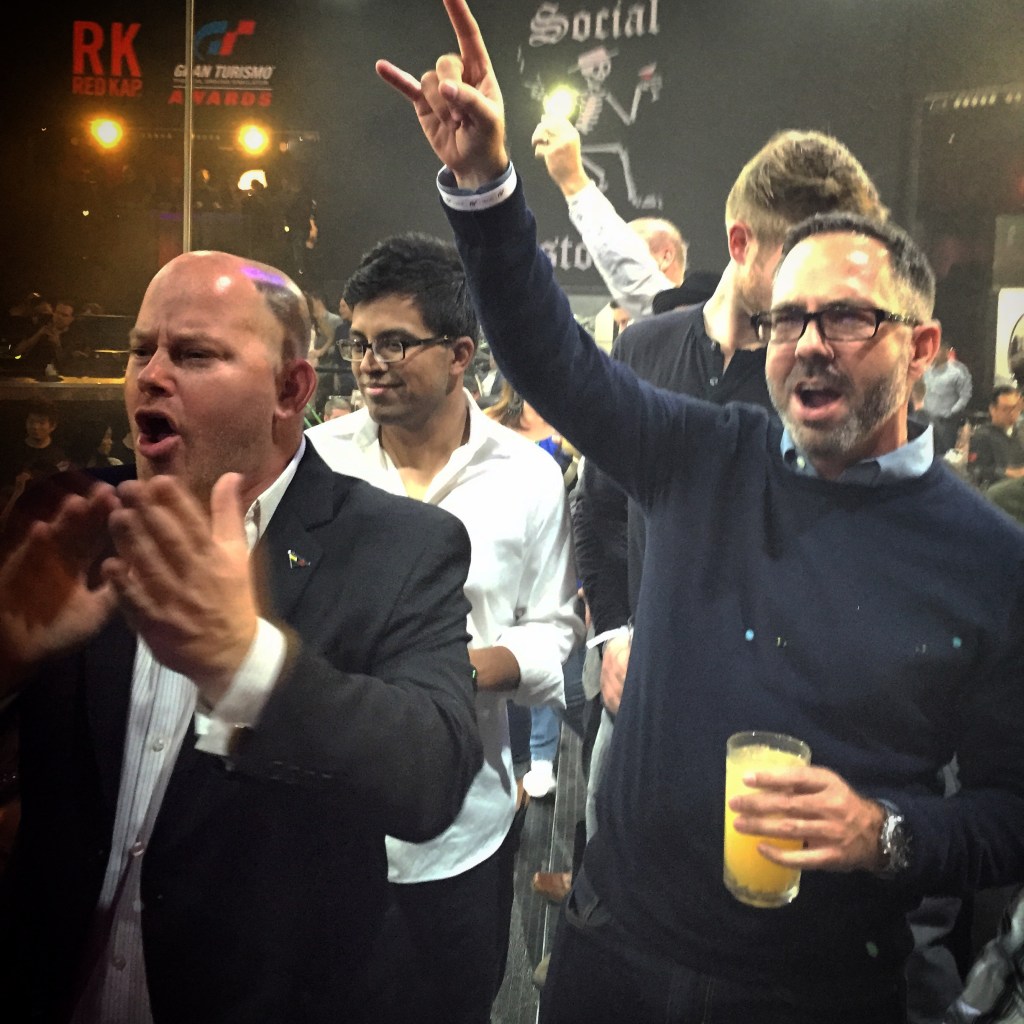
I am glad that in 2014, at one of my last SEMA Shows, after getting back from Japan that year, I found out that my favorite band would be performing at our event, which is unreal because out of the decades I had gone, I was never part of an event that had live music. So seeing Social Distortion play live, I’m glad I got to leave the industry on that note.
I can put on a front of staying at posh hotels, attending the best schools, having race-driver-like skills on and off the track, but when it comes to car culture, I’m no peacock, and I’m with Groucho Marx: “Please accept my resignation. I don’t care to belong to any club that will have me as a member.” I will always be a car enthusiast, in whatever form it takes, and I’m not resigning, just don’t count me as a tribalist tool.
For the record, I’d be down for a vampire rave, especially with my Filipino and other homies.
Shout out to: Charles and Sveta, Jenny Duong, Ayano Kawa, that chick at JKL, John and James and the giant peach, Stanley Chan, Nelson Kuo, Steven Tung, Andrew Platt, Brandon something, Stephen, John Chung, Cat head, Kenji, Ross, Arnell B, Edward K, uncle Herb/Driftwell, Frank Balogh, Ray I, Phil Wong, Dave Shih, Jim Ogawa, dude with the large parrot, Dr. Charles, Calvin Wan, Leo Now, Willie, Brian Urbano. For posterity: Viet Lam, Tin Tin, Takehiro Kitamura, Fuck you Dave Hsu, Rodney Willis, Gary Castillo, Junior Asper, Tony Fuchs, Stephen Papadakis, Adam Saruwatari, Ken Miyoshi, Myles Bautista, Ed Bergenholtz, Shaun Carlson, Lisa Kubo, Chris Rado, Vinny Ten, and all the others.
